
In the rapidly evolving landscape of financial services, community banks and credit unions face unique challenges and opportunities as they navigate the integration of artificial intelligence (AI) into their operations.
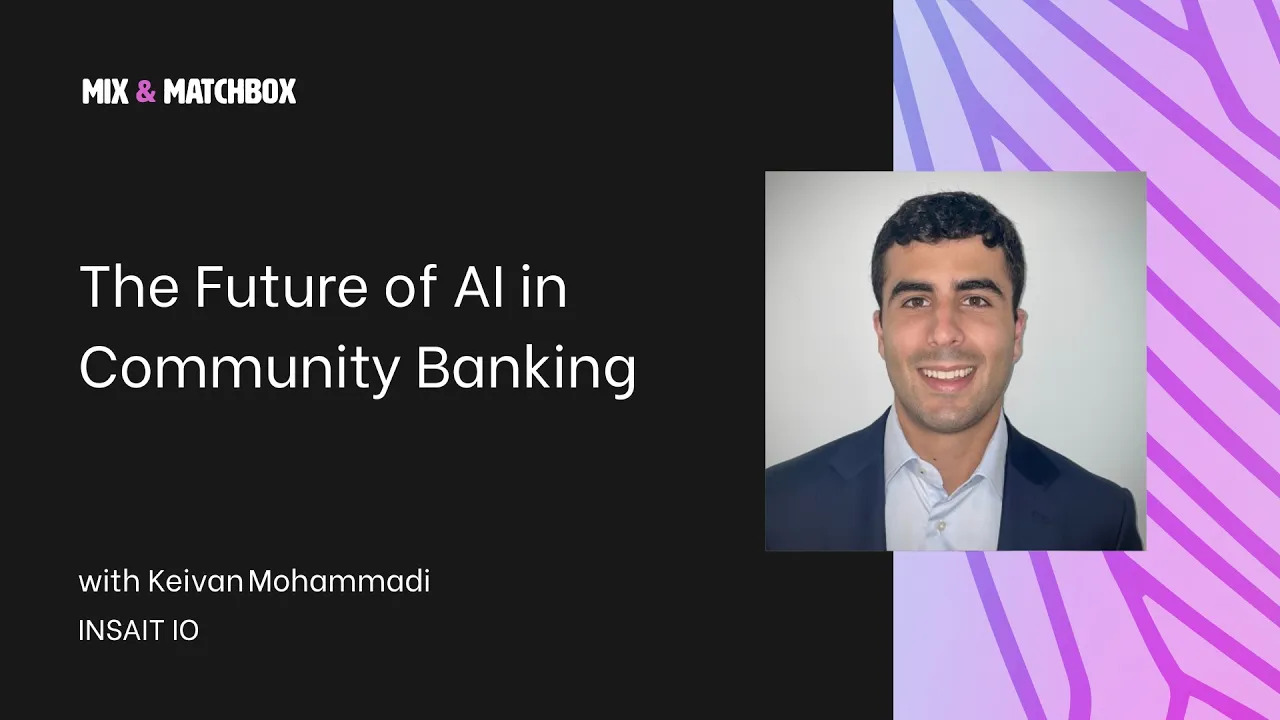
In this episode of the Mix & Matchbox Podcast, host Brent Feldman sat down with Keivan Mohammadi, Director of Sales at Encore AI (formerly Insait IO), to discuss the future of AI in community banking. They explore the digital-vs-reality gap, the hype surrounding AI, and practical strategies for successful implementation.
Keivan’s Career Journey: From Intern to AI Leader
Keivan’s journey into the fintech world began during his college years at William and Mary, where he interned for the Chief Risk Officer at Finastra. This experience opened his eyes to the significant technological gaps in the banking industry, where advancements often lagged by a decade. After graduating, he joined Finastra, focusing on sales for community banks and credit unions, before moving on to EnCino and ultimately landing at Encore AI, where he now leads AI sales.

The Digital-Vs-Reality Gap in Banking
One of the most pressing issues facing community banks is the disparity between what bank leaders express as their digital aspirations and what they can realistically execute on. Keivan explains that many banks are hesitant to embark on large-scale digital projects due to the rapid pace of technological advancement.
A bank may find a technology provider that checks all the boxes in the moment but isn’t adaptable long-term. Often, by the time a bank implements a solution, a better option has already emerged, leaving them feeling stuck with outdated technology.
Addressing The AI Hype
Another factor that often holds banks back from digital advancement is drinking the AI kool-aid without taking the time to determine if it’s actually needed or how it will fit into their business structure. It seems like almost every technology provider has some shiny new AI tool that they’re pushing these days. It may seem valuable during the pitch, but then banks find out later on that it was unnecessary or they don’t have the resources to take full advantage of it.
Keivan expressed frustration with the overwhelming messaging surrounding AI solutions, where vendors claim to have the answer to every problem. This “AI solves everything” narrative can lead to confusion and skepticism among bank leaders. Instead, he advocates for a focus on specific use cases and tangible results.
To navigate the AI landscape effectively, banks should:
- Identify specific pain points that AI can address.
- Evaluate the credibility of AI solutions based on real-world applications.
- Prioritize results over flashy technology claims.
Where AI is Gaining Traction
Currently, AI is making significant inroads in two primary areas: internal operations and customer-facing support. Keivan notes that many banks are cautious about deploying AI in customer interactions due to fears of misinformation and liability. This hesitation is valid since AI is often pulling information from various sources across the web, some credible and some not so much… AI also does something called “hallucinating” where it makes up false information that sounds convincing. This happens when there’s gaps in the information it’s able to pull, so it decides to fill in the blanks itself.
Customer Support Chatbots
Despite these risks, there are areas where AI can be implemented effectively. Customer support chatbots are one of the most common entry points, handling routine questions like branch hours, card activation, or balance inquiries so human staff can focus on more complex issues. Because these interactions are narrow and repetitive, there’s less room for the chatbot to wander off script and hallucinate.
Streamlining Internal Processes
Internally, AI-driven tools are helping banks streamline processes that used to eat up staff time, things like summarizing documents, flagging anomalies in transactions, or automating routine compliance checks. Since these tools support employees rather than speak directly to customers, there’s a built-in human checkpoint before anything reaches the public, which lowers the liability risk considerably.
Guided Customer Experiences
Guided customer experiences are another promising use case, particularly for loan applications and account openings. Here, AI can walk a customer through a structured process step by step, collecting information and answering procedural questions, while the actual decisioning and any nuanced advice still gets handled by a human. This keeps AI in a supporting role rather than an authoritative one, which is exactly where banks seem most comfortable putting it right now.
Overcoming Barriers to AI Adoption
Keivan shares real-world anecdotes illustrating the challenges banks face when adopting AI, including a cautionary tale of a $20 million lawsuit stemming from incorrect information provided by an AI agent. The fear of risk and compliance issues often stifles innovation in the banking sector.
To overcome these barriers, banks should:
- Define narrow use cases for AI implementation. Rather than deploying AI broadly across departments, banks should start with a specific, well-defined problem, something like summarizing internal documents or answering FAQs about account types. Starting small limits the margin for errors and makes it easier to monitor exactly what the AI is doing and why.
- Conduct mini proof-of-concept (POC) tests with non-sensitive data. Before touching real customer or financial data, banks can test AI tools using low-stakes, non-sensitive information like internal documentation, publicly available data, or synthetic datasets. This lets teams evaluate accuracy, reliability, and edge cases in a sandbox environment where a mistake doesn’t carry legal or reputational consequences.
- Gradually increase exposure to AI solutions based on performance metrics. Once the tests prove reliable, banks should expand its use incrementally rather than rolling it out all at once. A phased approach lets banks build trust in the technology (and in their own oversight of it) before it’s handling anything critical.
A Blueprint for Successful AI Implementation for Financial Institutions
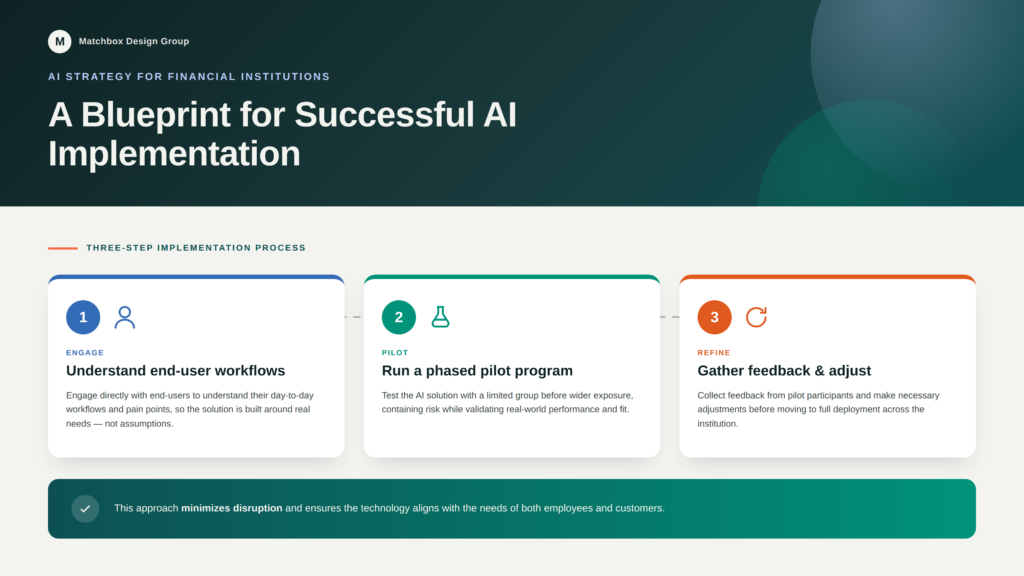
Keivan outlined a straightforward implementation process for AI solutions, emphasizing the importance of stakeholder alignment and gradual rollout. Before selecting or building any AI tool, banks should talk directly to the employees who will actually use it and find out where their time is going and where they’re getting stuck.
Rather than rolling a new AI tool out bank-wide, it should first be tested with a small group (a single branch, department, or team) so any issues surface in a contained setting. This mirrors the mini-POC approach from earlier: keep the blast radius small while the tool is still proving itself, so mistakes are cheap to catch and cheap to fix.
Once the pilot is running, banks should actively collect input from both the employees using the tool and, where applicable, the customers interacting with it, then use that feedback to refine the solution before expanding it further. This step is what turns a pilot into a useful tool and it gives the bank a chance to fix workflow friction or accuracy issues while stakes are still low.
Establishing Guardrails for AI
As banks integrate AI into their operations, establishing guardrails is essential to mitigate risks. Keivan emphasized the importance of controlling the scope of information fed into AI systems and defining clear business rules for AI behavior.
Key considerations for guardrails include:
- Narrowing the data scope to relevant information only.
- Implementing business rules to guide AI actions.
- Incorporating human oversight to review AI outputs and decisions.
Enhancing User Experience and Conversion Rates
One of the most significant challenges banks face is low conversion rates on digital forms. Keivan pointed out that static forms often lead to abandoned applications, resulting in lost opportunities. To combat this, banks should consider implementing conversational AI solutions that provide guidance throughout the application process.
Transforming Static Forms into Guided Experiences
Traditional digital forms ask customers to fill in a bunch of fields with no context or support, which can cause drop-offs. Conversational AI can turn that same form into a guided, back-and-forth experience where it asks one question at a time, explains why information is needed, and adapts based on previous answers. The result feels less like paperwork and more like a conversation with a helpful banker.
Utilizing AI to Answer Customer Questions in Real-Time
Applicants often abandon a form the moment they hit a question they can’t answer or don’t understand. An AI assistant embedded in the application flow can resolve that friction instantly, answering questions about eligibility, documentation, or terms without forcing the customer to leave the page, call support, or start over later.
Ensuring the Digital Experience Mirrors the In-Branch Experience
Community banks have long differentiated themselves through personal, relationship-driven service. That same warmth and responsiveness needs to carry over online. When the digital experience offers the same level of guidance and reassurance a customer would get from a teller or loan officer, banks preserve their competitive advantage even as more interactions move to digital channels.
Strategic Advice for Community Institutions
For community banks and credit unions looking to modernize their services, Keivan recommends focusing on attracting younger customers. With the average age of bank customers rising, it is crucial to adapt to the preferences of a younger demographic that values technology and convenience.
Key steps for community institutions include:
- Modernizing the auto loan and deposit processes to appeal to younger customers.
- Utilizing AI to streamline onboarding and enhance customer interactions.
- Tracking key performance indicators (KPIs) such as new account conversion rates to measure success.
Embracing the Future of AI in Community Banking
The integration of AI into community banking presents both challenges and opportunities. By understanding the digital-vs-reality gap, focusing on specific use cases, and implementing AI thoughtfully, community banks can enhance their operations and customer experiences.
For more insights on how to modernize your institution with AI, visit Insait IO and explore the potential of AI-driven technology in community banking.
Ready to bring these ideas to life on your own platform? We specialize in website rebuilds and digital marketing built specifically for banks and credit unions. Whether you need a website that can support conversational AI and a smoother digital experience, or a marketing strategy to reach today’s banking customers online, reach out to Matchbox to get started.
Never Miss an Episode
Get more insights on design, marketing, and all things digital. Subscribe to our Mix & Matchbox YouTube channel and join the conversation.
Want to Be Featured?
We love connecting with fellow creatives, marketers, and industry pros. If you’d like to share your story or expertise on the Mix & Matchbox podcast, let’s chat.