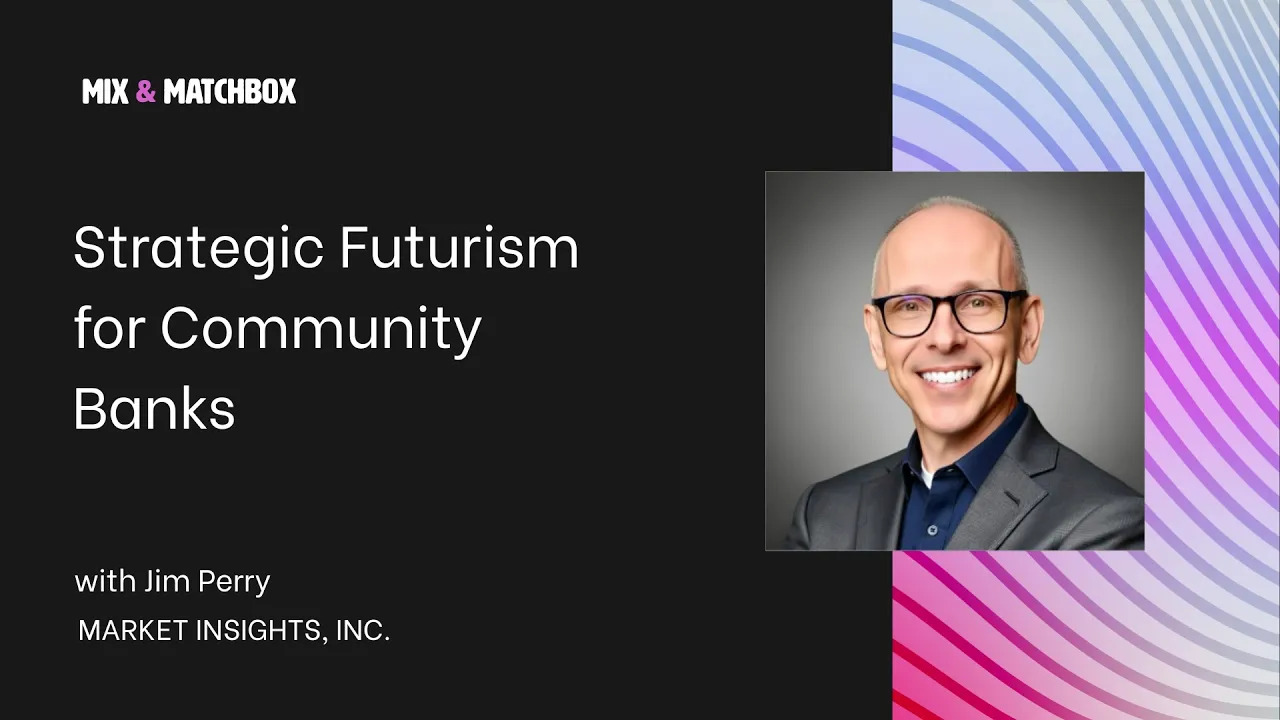

In a recent episode of the Mix & Matchbox Podcast, host Brent Feldman sat down with Jim Perry, a seasoned consultant at Market Insights, to discuss the role of strategic futurism in community banking. This blog post delves into the key insights shared by Jim, exploring the importance of strategy, the impact of AI, and the future of community banks.
Understanding the Role of a Bank Strategist
Jim Perry describes himself as a strategist rather than a traditional banker. A strategist helps banks position themselves for the future, much like a military general planning for battle — analyzing the current environment and preparing an institution for a range of possible scenarios rather than a single predicted outcome.
Central to that work is data: understanding the patterns hiding in an institution’s data is what separates informed strategic choices from guesswork. And because the banking landscape never holds still, a strategist’s true value is helping institutions navigate change effectively as it comes.
The Architectural Analogy
Jim draws parallels between banking strategy and architecture, an analogy shaped by his own experience living in a Frank Lloyd Wright-designed community. Just as a building must be designed with its environment in mind, banking strategies should be sculpted to the unique conditions of each institution.
There’s no one-size-fits-all approach. Every bank carries its own set of challenges and opportunities, which means the strategy has to be custom-built rather than borrowed from a competitor. That also means strategy should be site-specific. It needs to grow out of an institution’s actual market conditions instead of being imposed from the outside.
Underlying all of this is an appreciation for interdependencies: technology, customer behavior, and market dynamics don’t operate in isolation, and understanding how they relate to one another is essential to building a strategy that actually holds up.
The Importance of Independence in Consulting
Market Insights has made a deliberate choice to remain independent from execution partners, and Jim sees that independence as core to the value they provide. Because the firm isn’t tied to specific vendors, its recommendations are impartial, meaning that they’re based purely on what’s best for the client rather than what benefits a partner relationship.
That independence also gives Market Insights the freedom to critique existing partnerships and technologies honestly, without worrying about damaging a referral relationship in the process. And by not selling implementation services themselves, the firm can stay focused on what it does best: developing effective strategy, rather than being pulled toward whatever solution happens to be easiest to execute.
From Branch Expansion to Branch Consolidation
Historically, community banks grew by opening new branches. Jim points to a significant shift away from that model. Many banks are realizing that maintaining a large branch network is expensive, and that expense often doesn’t translate into meaningful customer acquisition like it used to.
As customer interactions increasingly move online, digital presence has become more important to prioritize than physical footprint. The upside is that capital freed up through branch consolidation can be redeployed into technology and digital marketing efforts that actually move the needle for today’s customers.
The Current State of AI Adoption in Community Banks
AI is transforming the banking industry, but Jim notes that many community banks are still lagging in adoption. The first step toward catching up is an honest inventory. Banks need to assess where they actually stand today and identify where AI can meaningfully enhance the customer experience.
A common trap is what Jim calls “pilot purgatory” — running pilot after pilot without a clear strategy behind them, which burns resources without producing real progress. The better path is a customer-centric approach that starts with how customers are actually using AI, then adapts bank services to meet them there.
Agentic AI and Discoverability
As AI becomes more embedded in consumer behavior, Jim introduces the concept of “agentic AI” — AI systems that act on a consumer’s behalf, making decisions and recommendations rather than just answering questions.
In that world, consumers increasingly rely on AI to search for and evaluate banking products directly, which makes discoverability critical. If a bank isn’t visible to the AI systems doing the searching, it risks being overlooked entirely, regardless of how strong its actual offering is. Banks need to start preparing their strategies for a marketplace where a growing share of “customers” evaluating them aren’t human at all.
Cultural Barriers to Transformation
Technology and budget constraints get blamed most often, but Jim argues that culture is the real hurdle standing between most banks and meaningful transformation. Employees can be understandably hesitant to adopt new technologies or processes, especially when existing methods have worked well for years.
Overcoming that resistance takes leadership willing to challenge the status quo and actively encourage innovation rather than simply tolerate it. Ultimately, it comes down to organizational readiness. Banks need to honestly assess whether their culture supports experimentation and learning, and build that capacity deliberately if it isn’t there yet.
Consolidation, Mergers, and the Future of Community Banking
As the competitive landscape grows more difficult, Jim advises community banks to reconsider their assumptions about consolidation and mergers. That means weighing the real benefits of remaining independent against the potential advantages of merging with another institution.
Local expertise is genuinely valuable. When a local bank disappears, so does a certain depth of knowledge about community needs and risks that’s hard to replace. At the same time, mergers can provide the resources an institution needs to invest seriously in technology and stay competitive, so the calculation isn’t a simple one in either direction.
Data Analytics as a Core Competency
Looking ahead, Jim believes the banks that succeed will be the ones that treat data analytics as a genuine core competency rather than a side capability. That means prioritizing data-driven decision-making as central to understanding and serving customers, not just reporting on them after the fact.
Some banks will choose to become the financial infrastructure behind other brands, while others will remain customer-facing institutions in their own right. Neither path is automatically correct, but Jim’s point is that it needs to be a deliberate choice.
One Actionable Insight for Community Bank Leaders
If there’s a single takeaway Jim returns to throughout the conversation, it’s this: don’t confuse today’s success with tomorrow’s readiness. Performing well right now is no guarantee of future success, and leaders who wait for a problem to show up before adapting are already behind. The work of preparing for what’s next has to start before it’s urgent.
For more insights and updates on the future of banking, be sure to subscribe to Jim Perry’s Bank Forward newsletter and follow him on LinkedIn. Also make sure to check out our bank marketing blogs for in-depth tips and strategies.
Never Miss an Episode
Get more insights on design, marketing, and all things digital. Subscribe to our Mix & Matchbox YouTube channel and join the conversation.
Want to Be Featured?
We love connecting with fellow creatives, marketers, and industry pros. If you’d like to share your story or expertise on the Mix & Matchbox podcast, let’s chat.