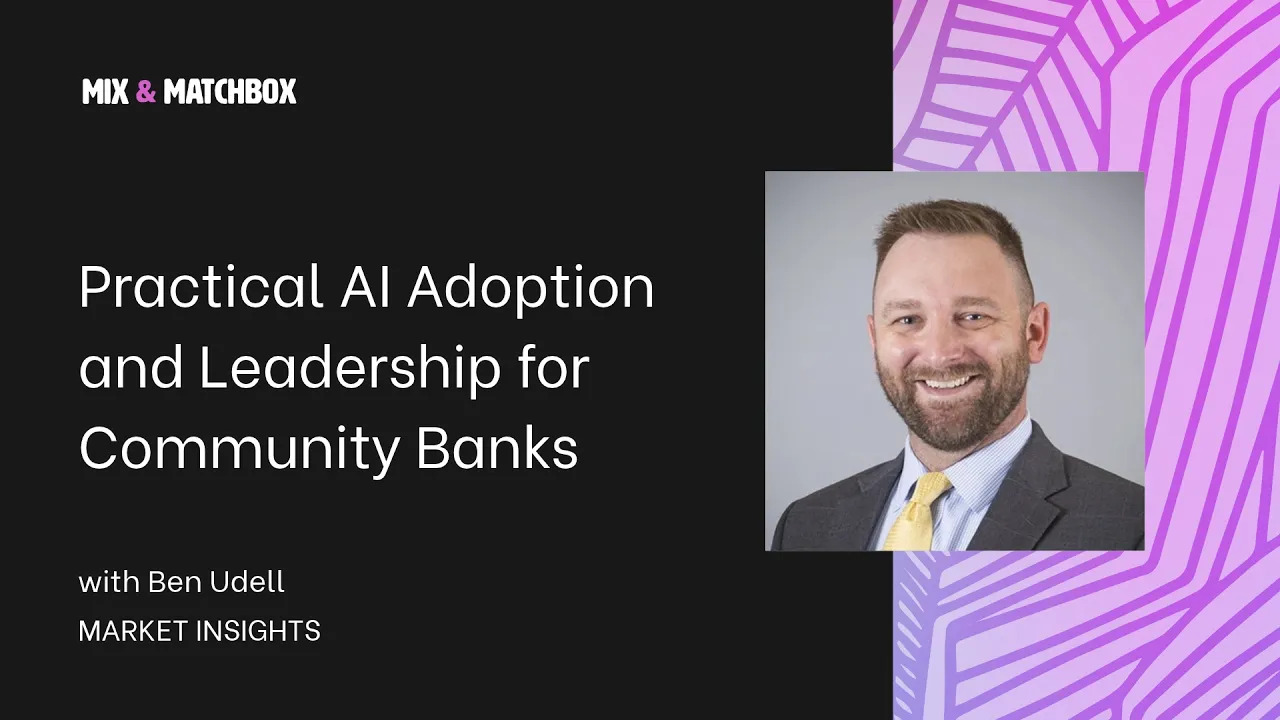

When people talk about AI adoption in banking, the conversation often gets stuck in the wrong place. Many obsess over the tools, the models, the buzzwords, and the fear. But in Ben’s experience, especially in community banking, the real issue is not technology. It’s leadership, culture and change management.
Ben’s central point is that AI isn’t something a bank can buy, install and check off a list. It changes how a team thinks, works, shares ideas and leads. Banks that treat it like another software rollout tend to miss the bigger opportunity. Banks that treat it as a change in how they operate often start seeing results right away.
“I spent years in a community bank wearing a lot of different hats. That experience shaped how I think about this space today. Community banks do not have the luxury of endless staff, endless time, or endless margin for confusion. People are already juggling customer relationships, marketing, digital banking, compliance, lending, and community involvement. So when AI comes into the picture, the question is not, ‘Can this replace us?’ The better question is, ‘How can this help us do the work we already need to do, faster and better?’”
– Ben Udell, Market Insights
Below, we’ve pulled together the highlights from Brent and Ben’s conversation. They cover why so much AI use is happening behind the scenes, what ROI looks like for everyday tools and how AI ties into keeping good talent.
Why AI Adoption in Community Banking Is Really a Leadership Problem
Most banks know that AI matters, but very few have actually figured out how to adopt it in a meaningful way. Community financial institutions are naturally risk-averse in order to safeguard their customers and operations. That risk aversion is understandable, but it can often hold these institutions back from utilizing emerging tools like AI.
When it comes to AI, there is no instruction booklet. AI has only been mainstream for a few years in a mass-market sense, but everyone is still figuring it out. Then on top of that, people have day jobs. They’re serving customers, managing operations, and keeping everything moving. They don’t have time to learn a new tool and even more importantly they don’t get paid to be an AI specialist. It’s not an individual employee’s responsibility to figure out how to integrate AI into day-to-day operations, that responsibility falls on leadership.
Leadership needs to decide:
- What acceptable AI use looks like
- Where AI can help immediately
- How people should report wins and failures
- How accountability will work
- What success should look like in practical terms
If leaders fail to have these discussions and make these decisions, they’re at risk for falling behind competitors who are actively using AI to improve operations.
What “Shadow AI” Means and Why It Matters
There’s a lot of AI use happening in the shadows right now. That phrase may seem dramatic, but it’s really not as nefarious as it sounds. It just means people are experimenting privately because they don’t feel comfortable sharing what they’re testing.
If someone uses AI to draft something, tighten up a workflow, summarize a document, or generate a first draft, they may not want to raise their hand unless they know their leader is going to support that behavior. They may be scared that leadership considers it a “distraction” or doesn’t approve of AI usage. If the organization doesn’t share their stance on AI, people are more likely to stay quiet and use it secretively.
The problem with private AI usage is that there’s no defined guidelines or skill sharing happening. One person’s breakthrough may never see the light of day, which is a huge disservice to their team. Every AI use case that stays private is a lost opportunity to scale knowledge.
If you want to build momentum, you need a culture where people can feel comfortable saying things like:
- “Here’s the prompt I used.”
- “Here’s what worked.”
- “Here’s what failed.”
- “Here’s how I’d do it differently next time.”
When someone on your team figures out how to save three hours a week, that should not live and die in their inbox. It should be shared, discussed, and refined.
Start Small, Win Fast
One of the most frustrating conversations in banking right now is the debate over ROI for basic AI tools. If your organization is arguing over whether a $30 a month AI license is worth it, you’re probably asking the wrong question.
The math really isn’t that complicated. If a tool saves even just one person a handful of hours a month, it’s already worth it. The focus should be on non-monetary value like improving a customer interaction, helping a lender build a better narrative, or giving a marketer a usable first draft in 30 seconds instead of 30 minutes. Those are all big wins for a financial institution, and that’s before you even get into bigger, more advanced workflows.
Ben talks about seeing people go from “I don’t know why we’d use this” to “Oh wow, this just saved me a full morning” . That’s why he always encourages banks to start with everyday AI. Not some grand vision or big platform rollout, but rather the small stuff that helps people get stuff done like:
- Drafting emails
- Summarizing meeting notes
- Rewriting policy language
- Creating marketing copy
- Building a first-pass loan narrative
- Organizing to-do lists
- Brainstorming internal communications
If you can create $30 of value with a $30 tool, you’re already winning. And in many cases, you can create much more than that.
AI and Talent Retention
One major benefit of AI usage for banks and other financial institutions is talent retention. If your team is expected to compete in a fast-moving environment but you refuse to give them modern tools, what do you think is going to happen? Eventually, your best people look across the street and see an organization that is willing to help them work smarter. That’s what Ben likes to call the reverse ROI problem.
It’s not just about what you gain by adopting AI, it’s about what you lose when you don’t. In community banking, people are already stretched thin. So if AI can remove some of the repetitive work, the low-value administrative drag, and the blank-page problem, it creates efficiency and goodwill.
It’s also widely appealing to younger team members or what older generations lovingly refer to as digital natives. For the younger generation, AI usage at an organization is expected. One of the main reasons being that they already use it outside of work on a regular basis. If your organization doesn’t support AI usage, they’re most likely going to find someplace else that does.
The Leadership Playbook for AI Adoption
If you want AI to spread inside your organization, leaders need to do more than simply approve an AI tool. They need to check in with their team to see if they’re AI and in what ways they’ve found it useful. They also need to do their own research to figure out how AI can best serve their organization.
Here’s a few steps for leadership to take in order to effectively implement AI into their opterations:
1) Use AI Yourself
Start with your own work before asking anyone else to change theirs. Choose one or two tasks you do every week, like drafting emails, getting ready for meetings or summarizing long reports, and try using an AI tool. You’ll find out quickly where it saves time and where it falls short. Your team will also take you more seriously because you’re speaking from experience.
2) Share How You’re Using It
Once you’ve discovered a few useful workflows, start telling people about them. Share a prompt you used in a staff meeting, record a quick two-minute screen share, or mention in a team email that AI helped you draft the update. This approach helps you warm up your team members to AI usage and demonstrate practical ways that it can be useful. It’s way better than making everyone sit through a lengthy slideshow presentation where you talk vaguely about the benefits of AI. The key is to show, not tell.
3) Ask Your Team to Share Examples
An important step is to let your team know that AI usage is approved at your organization and encourage them to share ways that they’ve been using it as well. Don’t count on people to volunteer to share their experiences right away, especially if they’ve been experimenting quietly. Try asking them directly, adding an “AI win of the week” item to team meetings, or set up a shared space where people can post prompts and results. When someone shares a useful workflow, make sure to share it with other departments that could benefit.
4) Establish Acceptable Use Cases
People are more willing to try AI when clear guidelines exist. Work with your compliance and IT teams to write a short, plain-language list of what’s approved, what needs review and what’s off-limits. For example, drafting marketing copy might be fine, while entering customer account information isn’t. Keep it to a page or two and revisit it as often as you need to.
5) Reward Experimentation
Make sure to reward wins and failures. This might seem counterproductive, but if people only get recognized for wins, they’ll stop trying new things in fear of it failing. Recognize the effort, even if it doesn’t end up working out. For example, you could share a shoutout in a company meeting along the lines of “Bill has been testing ways to organize our internal training documents this week, he hasn’t landed on a solution just yet, but we really appreciate his effort!” This type of recognition encourages employees to test out new workflows without the fear of wasting time or feeling pressure to find a solution right away. Failure is a critical part of the learning process.
6) Define Accountability Clearly
Make sure everyone understands that AI doesn’t change who’s responsible for the work. Whoever sends, publishes or approves something owns it, whether AI helped or not. Spell out what review looks like for different kinds of work, such as fact-checking numbers, checking tone and confirming sources, so people know what’s expected before anything leaves their desk.
How to Approach AI Governance and Risk
Managing risk is a critical part of banking. Leaders need to recognize that you can manage risk and use AI tools to improve workflows. Both can exist at the same time.
You’ll want to conduct a risk assessment of the AI tools you plan on approving and using at your organization. To do this, you can reference the same playbook you already use for vendor management and software oversight. If you’re evaluating a new system, you already know what to look for like privacy statements, data encryption, SOC reports, data retention policies, training on data usage and internal approval workflows.
You’ll also need to make sure that your employees understand that accountability does not move away from the human being using the tool. If you publish something, you own it. If you send it out, you stand behind it. That’s why Ben is a big advocate for guardrails without gridlock. You want enough structure to be responsible, but not so much structure that nobody ever tries anything.
If you want to see a smart, practical way to apply this kind of thinking, check out Ben’s website benudell.ai.
AI vs. Human Error
One of the main things that holds people back from using AI is they worry about it making mistakes. Yes, it’s true, AI can definitely make mistakes and hallucinate. It can misread a source, produce low-quality work or not give you with the result you wanted. But let’s not pretend human beings are perfectly accurate either.
Bankers, tellers, managers, young employees and experienced employees all make mistakes. Sometimes the mistake is small, and sometimes it matters a lot. The point is, neither humans nor AI tools are perfect. The difference is that AI can often give you an auditable trail. This gives organizations something to review, correct, and learn from.
The key here is to apply the same accountability standard to AI that you apply to people. Never take an AI response at face value, always make sure to evaluate it before moving forward. Review the output, fact-check it, remove bias and make sure the data source is right. Don’t assume the tool is correct just because it sounds confident.
At the same time, don’t use the possibility of error as a reason to reject the tool entirely. That would be like refusing to use email because someone might send the wrong attachment.
Practical AI Use Cases for Community Banks
If you’re wondering where to begin, start with the work your team already does. AI is useful across the entire bank, not just in the marketing department.
Here are some examples of how different departments within your bank can utilize AI:
- Marketing: Teams can use it to brainstorm campaign themes for a new product launch, draft a month of social posts or write a few versions of an email subject line to test. It can also refresh dated website copy, such as rewriting a jargon-heavy checking account page in plain language. The output works best as a first draft, your team still adds the local knowledge, brand voice and compliance review.
- HR: AI can turn a dense benefits document into a one-page summary employees will actually read, or draft announcements for open enrollment, policy updates and new hires. It can also help pull scattered onboarding materials into a clear first-week checklist so new employees know what to expect and managers don’t have to piece it together each time.
- Lending: Lenders can use AI to draft a first-pass loan narrative from their notes, so they’re editing instead of staring at a blank page. It can also help them organize the questions to ask a borrower during underwriting, or lay out the strengths and risks of a deal before it goes to committee. Make sure any borrower information stays within the tools and guidelines your bank has approved.
- Operations: AI can help turn a long, outdated procedure manual into a clean step-by-step guide, rewrite confusing instructions so new staff can follow them, or build checklists for recurring tasks like branch opening and closing or month-end processes. It’s a practical way to cut down on errors and spend less time answering the same questions.
- Leadership: AI can draft talking points for an all-staff meeting, organize a quarter’s worth of updates into a clear board summary or outline a few strategic options with the pros and cons of each. It can also act as a thinking partner, which is how Ben uses it. You can talk through a decision, have AI organize your thoughts, and then refine from there.
- Meetings: Almost every department can benefit from this one. AI tools can capture notes during a meeting, pull out decisions and action items, and turn a rambling discussion into a short recap with clear owners and next steps. Fewer things fall through the cracks, and nobody has to spend half an hour afterward writing up notes. Just make sure everyone in the meeting knows when a recording or transcription tool is running and consents to it.
Final Thoughts: Bring AI Out of the Shadows
Right now we view AI as a special skill that we all have to learn, but in a few years it will just be natural part of how work gets done. Think about the iPhone or the internet. At first, people asked, “What do I even use this for?” and now it’s become second nature for most people. The organizations that adapted early gained an advantage and the ones that hesitated were playing a perpetual game of catch up.
AI is heading in that same direction. The organizations that win will be the ones that make AI feel normal, useful, and safe enough to incorporate into their workplace culture. The organizations that lose are the ones who reject AI and refuse to adapt.
When people have the right tools, they do better work. They move faster, think more critically and spend more time on the parts of the job that matter most. But none of that happens overnight. As a leader, you have to make a conscious effort to bring AI out of the shadows by encouraging experimentation and talking about it openly.
If you want to continue the conversation, you can connect with Ben on LinkedIn or visit benudell.ai. And if you’re looking for live demos and practical examples tailored to bankers, take a look at Vibe Coding for Bankers.
Never Miss an Episode
Get more insights on design, marketing, and all things digital. Subscribe to our Mix & Matchbox YouTube channel and join the conversation.
Want to Be Featured?
We love connecting with fellow creatives, marketers, and industry pros. If you’d like to share your story or expertise on the Mix & Matchbox podcast, let’s chat.